Showing posts with label Urban heat islands. Show all posts

Thursday, 28 May 2015

Why we should worry more about the poor during extreme heat events?


The month of May is generally the hottest time of the year in India. This time it has been unbearable. Certain parts of India are suffering from extreme heat - soaring temperatures (40C to 50C) have been reported in Andhra Pradesh, Telangana, Delhi, and Maharashtra resulting in more than 1000 deaths in less than one week, and the numbers continue to rise. Alarmingly, this is not a rare occurrence. Higher peak temperatures and longer periods of heat waves are becoming increasingly common in many parts of the world  as it does in India where it seem  to be recurring with regularity.2014 witnessed high temperatures in Andhra Pradesh, Delhi and Odissa. Similarly in 2013, 2012, and 2011, heat wave gripped many parts of the country with  2014 the hottest year on record in India.

Records from the National Climatic Data Centre indicate that the average global temperature across land surfaces was 1.68°C (3.02°F) above the 20th century average of 3.2°C (37.8°F). The Earth's surface temperature has shown accelerated warming during the last two decades due to the cumulative effects of human activities in the past 50 years, which have altered the atmosphere’s chemical composition by the accumulation of greenhouse gasses that trap heat. Exploitation of our forests and unrestrained development have led to deforestation resulting in the removal of trees-our planet's  natural heat moderators. Rampant urbanisation has led to increased temperatures due to urban heat islands. When tree cover is replaced by concrete buildings that naturally absorbs heat and retains less water, temperatures rise concomitant with the rise of urban sprawls.

Consequently human activities lead to extreme heat events - weather that is different from the usual, is abnormally hot and humid, and sustained over longer periods. Extreme heat events are increasingly being reported in many parts of the world in recent years often resulting in heat-related illnesses and deaths and  disproportionately affects the poor in developing countries.

 The casualties in the ongoing  Indian heat wave are largely  construction workers, elderly and the homeless.
Why are the poor affected more?

Lack of access to drinking water

In developing countries, people living in poverty generally have poor access to clean drinking water. Extreme heat events often goes hand -in-hand with general water shortage which limits the amount of water available to the poor contributing to severe dehydration. 

Inadequate shelter from heat 

Often the poor live in dwellings that lack adequate protection from heat, with many urban poor living in makeshift houses in slums devoid of  heat alleviating devices such as electric fans.

Occupational exposure to heat 

Whilst the advice during extreme heat events is to stay indoors, away from the heat, many poor engage in outdoor manual work for sustenance, often in urban areas where temperatures are higher which makes them increasingly prone to sunstroke and dehydration. Regardless of the danger posed by outdoor work in extreme heat, they are forced to labour in potentially lethal conditions, ironically, to survive.

Limited access to healthcare

The poor lack access to healthcare for heat-related illnesses which sometimes leads to fatal consequences.

Vulnerable elderly

Increased age (65 and over)  is a primary risk factor for heat- related illnesses regardless of socio-economic status, but the elderly poor are adversely affected to the greatest extent. This is due to the restricted ability of the older people  to change their physical environment and  their limited ability to access facilities such as water, re-hydration drinks, and medical aid, that local authorities might provide during times of extreme heat events.Additionally the elderly poor may have untreated health conditions like cardiovascular diseases and kidney diseases which predisposes them  to heat-related illness and death 

Homeless marginalised

Homeless people are highly vulnerable to heat -related illnesses due to a plethora of reasons – Often there is a high prevalence of untreated physical and mental illnesses, substance dependence, and mental health issues all of which contributes to their susceptibility. They may be less likely to take effective precautions from heat and may have poor access to medical help . Further, they may have no place to take shelter during periods of extreme heat.

 How can we help the poor before and during an extreme heat event?

  • The authorities must generate extreme heat event management plans far in advance, detailing how the poor would be taken care of during extreme heat events
  • Alert the poor using awareness campaigns before an impending extreme heat event so that they are prepared, can take precautions, and know what to do to protect themselves.

The points below can be used as a guide in generating extreme heat event management plan.

  • Make provisions for water, re-hydration solutions, and food aid to reach the poor
  • Provide emergency medical camps where the poor can seek medical aid. Additionally take  medical care to the point of need using mobile clinics- to the homeless and the elderly who may not visit the medical camps 
  • Provide emergency heat refuges  where the poor can take relief from heat. In times of extreme heat events large public outdoor spaces like stadiums and parks could be adapted to provide shelter from the sweltering heat.
  •  Provide financial relief that would help the poor to refrain from outdoor manual labour until the extreme heat events passes  .
  •  Provide appropriate clothing, sun hats, umbrellas to provide shade etc.

With increase in global temperature, extreme heat events will continue to reappear regularly. Nevertheless, virtually all of the extreme heat- related illnesses and deaths can be prevented by taking appropriate measures to ensure that the public stays safe during an extreme heat event, and that absolutely should include the poor.


Authors of this post - Ruth Stephen and Tim Whallett

Monday, 20 April 2015

Urban green spaces: Insights from Valencia

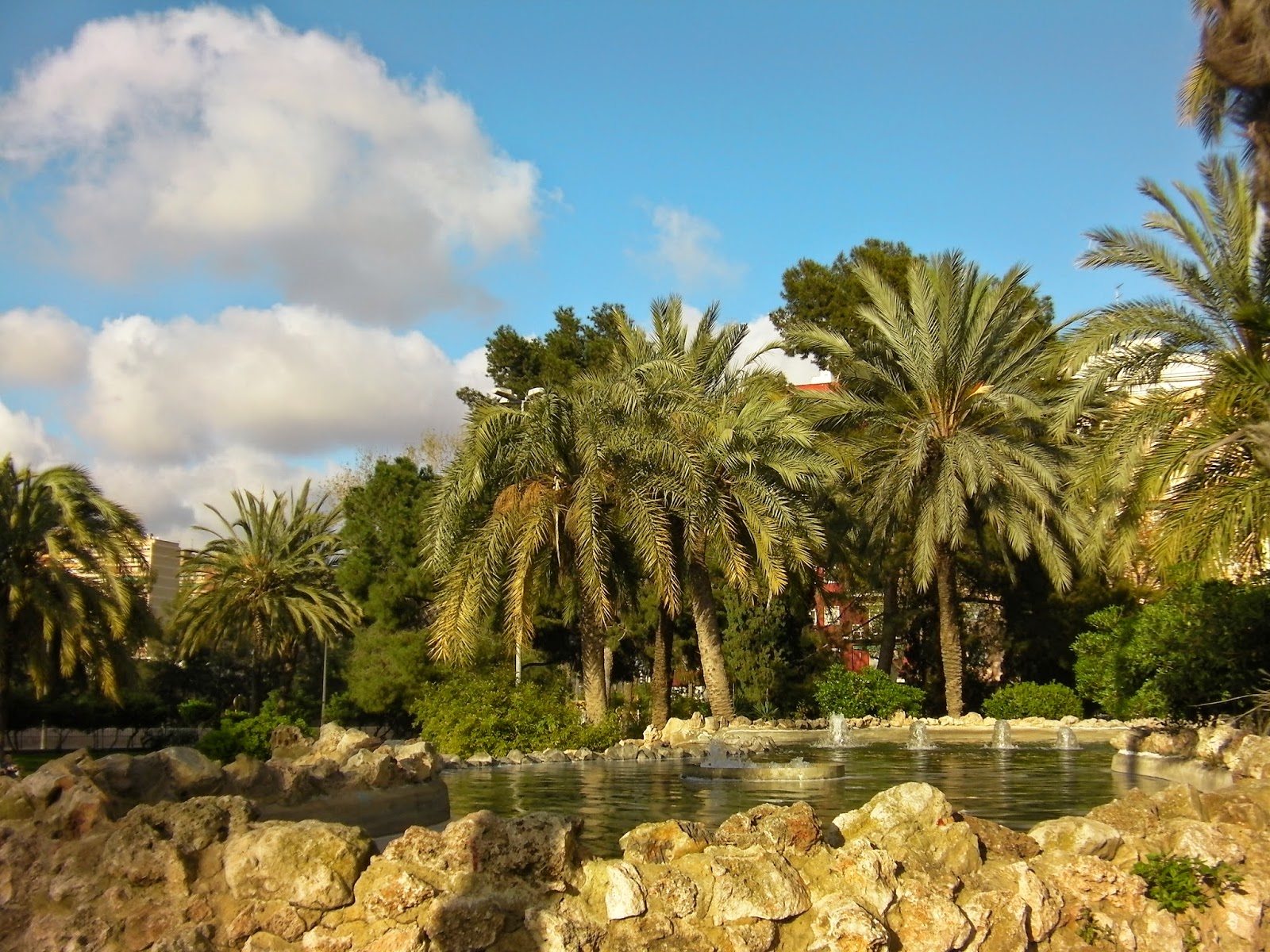
Visiting the city of Valencia in Spain for the first time, we were pleasantly greeted by the subtle aroma of orange blossoms in the air and the sight of beautiful oranges dangling from the orange trees that line the street pavements. Whilst many parts of the city are bordered with trees, there are also other green spaces,  such as beautiful small parks (like the one in the picture  shown below),
complete with Mediterranean flora such as palms, ficus, cycas, and orange trees. 


 The most impressive green space is perhaps the 9 km green belt that runs through the city-  the Jardi delTuria (Garden of the Turia), which is a credit to the city. The Turia is a Spanish river that empties into the Mediterranean near the city of Valencia. In 1957, it flooded and devastated Valencia. Consequently, the course of the river was artifically changed- now running along the city edge before meeting the Mediterranean. The original course of the river continues has been converted into an enormous green space resplendent with beautiful trees with pedestrian paths, cycle paths, and occasionally dotted with football grounds, cafes, athletics tracks, and gardens within the garden. Here city dwellers relax, play, or just get about their business, avoiding the traffic that plies overhead on the many bridges that cross the river bed. Buildings tower over either side of the Turia garden, comprising largely of apartment blocks and businesses. Our walk along the Turia garden in sweltering sunny April was very pleasant which made me realize the importance of green spaces in cities.


Urban heat islands and global warming

Cities have their own micro-climates. Human activities- buildings made of concrete,  asphalt roads , vehicular emissions, heat generated by people, and heat arising from equipment use, all contribute to temperature increases in the urban areas to levels that are significantly higher from the adjoining rural areas where temperatures remains close to air temperatures. Such urban areas are called ‘Urban heat islands’, a concept described over 200 years ago by Luke Howard, the father of meteorology. The term has been coined  as the warmer urban air lies in a ‘sea’ of cooler rural air.  According to the EPA, the annual mean air temperature of a city with 1 million people or more can be 1.8–5.4°F (1–3°C) warmer than its surroundings, going up to temperature difference as much as 22°F (12°C) on a clear, calm night.

Heat islands could not only affect the health of the urban inhabitants by causing heat -related illnesses (a topic discussed in the earlier post), but also contribute to global warming in general, and must not be ignored particularly as predictions indicate that by 2050 about 64% of the developing world and 86% of the developed world will be urbanised - leading to amplification of the issue. Whilst urbanisation cannot be halted, it must be made sustainable.

Mitigation strategies for urban heat island effects

Among the four major strategies United States EnvironmentalProtection Agency (EPA) has suggested for mitigating the effects of urban heat islands, the first one is increasing tree and vegetation cover. The others are the installation of green roofs (roofs with plants grown over a waterproof membrane), installation of cool and reflective roofs (built from materials with high solar reflectance and high heat emittance), and building cool pavements (made of material with high solar reflectivity and good water permeability).

In this post, we will look at the EPA’s primary recommendation. This, in my opinion, is the one with the maximum impact and the least costliest. The major benefits of increasing trees and vegetation covers are the following:
They reduce surface and air temperatures by providing shade and by the process of evapotranspiration. Estimates indicate that evapotranspiration, alone or in combination with shading, can help reduce peak summer temperatures by 2–9°F (1–5°C). By providing shade to buildings, trees decrease the demand for air conditioning and indirectly decrease the need for energy use which, in turn, lowers greenhouse gas emissions and provides better air quality. Trees also function as ‘sinks’ for air pollutants and carbon dioxide. Trees improve the quality of life of city dwellers by enhancing the aesthetic value of their surroundings and promote biodiversity by providing habitats for diverse species.

Interestingly, it  also appears that for some trees living in an urban environment might not be bad after all. In a study in 2012, seedlings of oak were grown for one season at four sites along an urban–rural transect from Central Park in New York City to the Catskill Mountains in upstate New York  with a difference in average maximum temperatures of 2.4 °C and  difference in minimum temperatures of 4.6 °C.  Additionally, seedlings were cultured in growth cabinets simulating the seasonal differential between the city and rural sites. The researchers found that warmer temperatures associated with the urban environment, especially high night-time temperatures, lead to enhanced growth in these seedlings.

The necessity for a Green Channel Programme for our cities

Coming back to our example - Valencia- it appears that the city is going in the right direction with its tree and vegetation cover initiatives. The green spaces and the green belts are not only aesthetically pleasing, but also reduce the heat (personal experience). Increasing the vegetation cover in cities is something where more is less. Thus, Valencia and other cities who have such initiatives cannot rest on their laurels. We really need to have green channels through our cities to cool the urban heat islands.


References

http://www.valenciavalencia.com/sights-guide/turia.htm
http://www.epa.gov/heatisland/about/index.htm

Searle, S., Turnbull, M., Boelman, N., Schuster, W., Yakir, D., & Griffin, K. (2012). Urban environment of New York City promotes growth in northern red oak seedlings Tree Physiology, 32 (4), 389-400 DOI: 10.1093/treephys/tps027http://dx.doi.org/10.1093/treephys/tps027">10.1093/treephys/tps027
>


Disclaimer

By using this blog, you signify your agreement to this disclaimer. Do not use this website if you do not agree to this disclaimer.

This blog is published by Sarah Stephen and Ruth Stephen, and reflects the personal views of the contributors, in their individual capacities as a concerned citizen of this planet. The term 'Ecoratorio', as well as every graphic, opinion, comment, and statement expressed in this blog are the exclusive property of the blog publishers and contributors (© 2009 - present), unless explicitly stated otherwise, and should not be disseminated without the written consent of the author(s). The views expressed in this blog are not necessarily representative of the views of any school, college, University, company, organisation, city, town, state, country, or church where the author(s) have studied, worked, worshipped, or lived, and is not sponsored or endorsed by them.


The matter on this blog has been prepared for informational purposes only, and the reader(s) should not solely rely upon this information for any purpose nor should he/she assume that this information applies to his/her specific situation. Furthermore, the matter on this blog may or may not reflect the current and future trends/developments, may or may not be general or specific, accordingly, information on this blog is not promised, or guaranteed, to be correct or complete. The publishers and author(s) explicitly disclaims all liability in respect to actions taken, or not taken, based on any, or all, the contents of this blog. Thus, the reader(s) is/are reading the posts and arriving at conclusions about the information, or about the author(s), or otherwise, at his/her own risk.

This blog may contain weblinks, which are provided solely for the reader(s) convenience. Such weblinks to another blog or website does not imply any relationship, affiliation, endorsement, responsibility, or approval of the linked resources or their contents (over which we have no control). Accessing these links will be at the reader(s)’s own risk.

The publishers and author(s) are not responsible for translation and interpretation of content. Occasionally, the blog might contain subjects which may be considered offensive from certain individuals’ points-of-view, and the author(s) refuses to accept any liability for any psychological, physical, and emotional reactions, short-term or long-term, which the posts might generate in the reader(s). However, each post in this blog is the individual opinion of the author(s) and is not intended to malign any city/town/village, state, country, continent, faith, religion, practice, ethnic group, club, organisation, company, or individual. Neither are the publishers and author(s) responsible for any statements bound to government, religious, or other laws from the reader(s)’s country of origin.

The publishers and author(s) reserves the right to update, edit, delete or otherwise remove, the posts or any comments, the latter of which might be deemed offensive or spam. The publishers and author(s) cannot warrant that the use of this blog will be uninterrupted or error-free, or that defects on this site will be corrected. The publishers and author(s) also reserves the right to publish in print media, in whole or part, any of the posts which might be an edited version. If the reader(s) has a problem with any post, the publishers and author(s) expects them to contact them, explaining the reasons for their discomfort. However, if the reader(s) choose to communicate with the publishers and author(s) by email, the reader(s) must note that since the security of unencrypted email is uncertain, sending sensitive or confidential emails holds the risks of such uncertainty and possible lack of confidentiality.

The publishers and author(s) reserve the right to change this Disclaimer, from time to time, in their sole and absolute discretion. If the reader(s) using this website after the institution of such changes, he/she is signifying their agreement to these changes. The publishers and author(s) also reserve the right to discontinue any aspect of this website at any time.

Thankyou.